Bee with Floral Wreath
A Sweet, Balanced Design That Feels Hand-Drawn—Not Over-Engineered
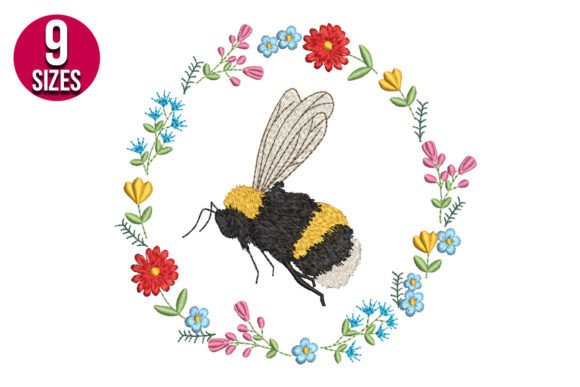
First impression? This isn’t a cartoon bee or a scientific illustration—it’s a friendly, gently stylized machine embroidery design that lands right between whimsy and refinement. The bee sits centered in a soft, asymmetrical floral wreath: petals curl outward just enough to suggest movement, not clutter; wings have subtle satin stitch gradients that catch light without looking plasticky; and the antennae taper cleanly instead of ending in stiff dots. It breathes. That matters—especially when you’re stitching it onto something meant to be held, gifted, or worn.
Where It Shines: Real Projects, Real Customers
Last week, I prepped a batch of linen tote bags for a local botanical-themed boutique—and Bee with Floral Wreath was my top pick for the front panel. Why? Because it reads clearly at 3.5 inches wide (a common hoop size for totes), holds detail without overwhelming the fabric’s natural texture, and feels intentional—not like an afterthought sticker. Customers responded immediately: “Is that hand-stitched?” “I’d buy three just for the bee.” That kind of quiet recognition is gold for Etsy sellers and small shop owners. It works equally well on baby onesies (scaled down to 2.25”), apron pockets, tea towels, and even as a standalone embroidered patch sewn onto denim jackets.
I also tested it on a lightweight cotton sweatshirt—medium-weight fleece backing, tear-away stabilizer, standard 40-weight thread. No puckering. No skipped stitches. The fill stitch density felt generous but not heavy, and the satin wing edges stayed crisp. That’s rare in floral-bug hybrids, where petal overlap often creates dense nesting or shadowed areas. Here, the wreath flows *around* the bee—not over it—so the central motif stays legible even after washing.
Where to Pause—and Why
- Small hoop sizes (under 3”): The outermost flower tips and wingtips start to compress. If you’re stitching on a cap visor or tiny baby cap, scale down only to 2.75” and run a test on scrap first—some delicate petal ends may lose definition.
- Stretchy fabrics: Not impossible—but avoid knits without cutaway stabilizer. The wreath’s gentle curves rely on stable fabric tension; too much give blurs the satin stitch transitions.
- Dark or heavily textured fabrics: The design uses moderate stitch density, so it won’t drown on burlap or thick terry cloth—but on black twill or charcoal French terry, consider switching to high-contrast thread (e.g., mustard yellow bee, ivory flowers) rather than default ecru. A printable mockup helps preview this fast.
- Curved surfaces (caps, mugs, curved pillow seams): Works best when placed flat—like the center front of a cap, not the crown curve. The wreath’s open shape adapts better than tight circular motifs, but extreme curvature still risks distortion.
What It Adds to Your Finished Product—Beyond Just “Cute”
Bee with Floral Wreath elevates perceived value without demanding premium pricing. On a handmade kitchen towel, it signals care—not just function. On a personalized gift (say, a baby’s first embroidered blanket), it reads as tender and timeless, not trendy-and-forgotten. For craft businesses, that builds trust: customers see intentionality in line weight, spacing, and balance—not just “a bug on fabric.”
It also supports brand consistency. If your shop leans into nature, slow living, or garden-inspired aesthetics, this design slots in naturally beside herb labels, pressed-flower patches, or honeycomb patterns. It doesn’t shout—it harmonizes. And for digital product sellers, it’s versatile in mockups: looks equally authentic on light linen, oatmeal canvas, and heather grey cotton.
Practical Designer Notes Before You Stitch
- Always test on scrap fabric—same type, same stabilizer, same thread colors you’ll use for the final piece.
- Check small details under magnification: Are the bee’s eyes fully formed? Do petal tips stay sharp, or do they blur into fill stitch? This tells you if your machine handles fine detail reliably.
- Review stitch density in your embroidery software. If it’s above 18,000 stitches, expect longer run time and heavier fabric impact—fine for home decor, less ideal for babywear.
- Confirm hoop size compatibility. Does your machine handle the full wreath width comfortably, or will you need to split? Some versions of this design come in multi-hoop layouts—check your file before hooping.
- Run black-and-white mockups. Helps spot contrast issues early—especially important if you plan to offer it as a digital embroidery file for others to use.
- Verify licensing. Since it’s labeled as a machine embroidery design for apparel and home goods, confirm whether commercial use (e.g., selling finished embroidered totes on Etsy) is permitted—or if you need an extended license.
Final Thought: A Design That Serves the Maker First
This isn’t just another bug-themed embroidery file. Bee with Floral Wreath respects the craft: it’s sized thoughtfully, stitched intelligently, and designed to age well—not just look good in a listing photo. Whether you’re stitching custom sweatshirts for a school fundraiser, building a cohesive line of nursery decor, or adding signature charm to your craft fair booth, it performs quietly and consistently. It doesn’t ask for special treatment—just decent stabilizer, appropriate thread, and attention to fabric choice. And in embroidery, that’s the highest compliment you can give a design.